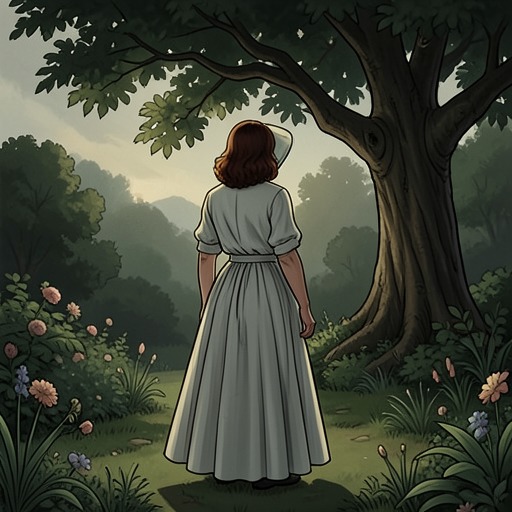
Nature as a solace for the mind
Diary of Anne FrankNature as solace is the sustaining force of the natural world in Anne Frank’s diary: because life in hiding sharply restricts access to the sky, trees, birds, moonlight, and open air, even a fragmentary view becomes a source of composure and hope. Nature is not merely scenery for her feelings. Its seasons and changing light offer a reality beyond the Annex’s cramped rooms and human tensions, while her repeated efforts to see it register how profound the deprivation has become.
Confinement and the altered value of nature
Anne recalls that before life in hiding, a blue sky, birdsong, moonlight, and budding blossoms would not have held her attention as they now do. Their heightened value follows from the conditions of confinement: she can usually look at nature only through dusty curtains attached to dirt-caked windows, and the view itself is diminished by the barriers between her and the outdoors. She describes this restriction as a loss for which nothing can substitute. The distinction is not simply between indoor discomfort and outdoor pleasure; it is between a life cut off from a shared source of beauty and the possibility of encountering it directly.
The diary records the work and risk involved in pursuing that encounter. On a hot night during Pentecost, Anne stayed awake until eleven-thirty to see the moon alone, but glare prevented her from looking properly, and she could not risk opening a window. On another night, she was upstairs while a window stood open and remained there until it had to be closed. The dark, rainy evening, wind, and racing clouds held her attention: it was her first face-to-face view of the night in a year and a half. Later, she went downstairs by herself to look through the kitchen and private-office windows, accepting a fear that had become less powerful than her longing. The dark, rat-infested house and the possibility of burglars did not erase the need to see the sky.
What the natural world offers
The relief Anne finds is at once physical, emotional, and spiritual. She insists that looking at the sky, clouds, moon, and stars genuinely makes her feel calm and hopeful, and that nature works better for her than valerian or bromide. It also leaves her humble and ready to face adversity with courage. These effects are described as lived experience rather than an abstract belief: nature’s presence changes how she feels and how she can meet what follows.
An earlier reflection gives this solace a religious dimension. Anne writes that a frightened, lonely, or unhappy person should go outside, somewhere they can be alone with the sky, nature, and God. In such solitude, she feels, it becomes possible to sense that things are as they should be and that God wants people to be happy amid nature’s beauty and simplicity. She extends the thought beyond her own circumstances, believing nature can bring comfort to all who suffer. The solace does not require that hardship has ended; it comes from an encounter that briefly places suffering beside a larger, enduring order.
Nature among the Annex’s relationships and routines
The force of the outdoors also appears in an intimate scene with Peter. Sitting together on a hard wooden crate among junk and dust, with their arms around each other’s shoulders and Peter playing with a lock of her hair, Anne is moved by the birds singing outside, the trees budding, the sun beckoning, and the blue sky. The moment gathers closeness and longing: private tenderness in the cluttered Annex exists alongside an outside world whose signs of spring intensify what she wishes for. Nature does not resolve the confinement or the uncertainty between people; it makes both the tenderness and the deprivation more palpable.
That contrast sharpens against the residents’ strained daily life. Anne hears sighs and suppressed complaints and sees dissatisfied faces, while the leaking toilet and stuck faucet make material discomfort immediate. She resists treating the prevailing gloom as the only possible response, arguing that each person must find a way to manage their own moods. The budding trees and beckoning sun do not cancel these irritations, but they establish another measure of experience—one that grumbling cannot fully contain.
Hope under the shadow of war
By July 1944, Anne sets her hope in direct tension with the destruction around her. She cannot build her life on chaos, suffering, and death; she sees the world changing into a wilderness, hears the approaching thunder that may destroy the people in the Annex too, and feels the suffering of millions. Yet when she looks toward the sky, she can still imagine that conditions will change for the better, that cruelty will end, and that peace and tranquility will return. The hope is not a denial of danger: the threat remains in the same account as the sky that sustains her.
Across these reflections, nature’s significance lies in the repeated act of seeing and in the limited, fragile access through which that act becomes possible. A glimpse from a window, a night view seized before the window must close, birdsong heard while sitting on a crate: these experiences do not free Anne from the Annex, but they give her calm, courage, and a ground for hope. The natural world remains beyond the reach of the restrictions surrounding her, yet its light and seasons enter the diary as more than symbols. They are a presence she longs for, encounters when she can, and trusts as a source of solace even when the future is shadowed.